Pills usually win on nutrients and accuracy: independent testing found standard multivitamins had about twice the vitamins and 3.5 times the minerals of gummies, with far less sugar. Gummies make sense if swallowing pills stops you taking vitamins at all. Whichever you choose, check the sugar, look for a third-party seal, and keep gummies away from children.
Affiliate disclosure: we may earn a commission from qualifying purchases through links on this page, at no extra cost to you. Read our disclosure.
Gummies vs pills at a glance
| Gummies | Pills (tablets and capsules) | |
|---|---|---|
| Easy to take | Yes, chewable and tasty | Harder for some people to swallow |
| Added sugar | Often several grams per serving | Usually none |
| Nutrient range | Often fewer nutrients; iron often missing | Usually a fuller range |
| Label accuracy | More variation found in testing | Generally more consistent |
| Risk with children | Higher, because they look like candy | Lower, but still keep away from kids |

Gummies often contain fewer nutrients
Independent tester Labdoor compared gummy and standard multivitamins and found that the standard multivitamins contained nearly twice the vitamin content and over 3.5 times the mineral content per serving. Iron is often left out of gummies, because it’s hard to include without affecting taste and texture.
The sugar question
Labdoor also found gummies had nearly 7 times the sugar and 4 times the calories per serving of standard multivitamins. If you take more than one gummy supplement a day, that sugar adds up, so check the “Total Sugars” line on the label. Some sugar-free gummies use sugar alcohols, which can upset some stomachs.
Label accuracy
In Labdoor’s testing, gummies showed bigger differences from their label claims than standard multivitamins for most of the key vitamins it measured. A study published in JAMA also found that most melatonin gummies tested were inaccurately labeled. Choosing a product with a third-party seal helps; see what third-party tested means.
Keep gummies away from children
Because gummies taste and look like candy, children can eat too many. Store them like medicine: high up and out of sight. Products containing iron need extra care.
Which should you choose?
- Choose pills if you want the widest range of nutrients, no added sugar, and the most consistent dosing.
- Choose gummies if swallowing pills is the reason you skip your vitamins. A vitamin you actually take beats one you don’t.
- Struggle with pills? Try the techniques in our guide to swallowing pills more easily before switching.
Nature Made was the first brand to get gummies USP Verified. Check the listing photos for the USP mark and the sugar per serving.
Browse USP Verified gummies on Amazon →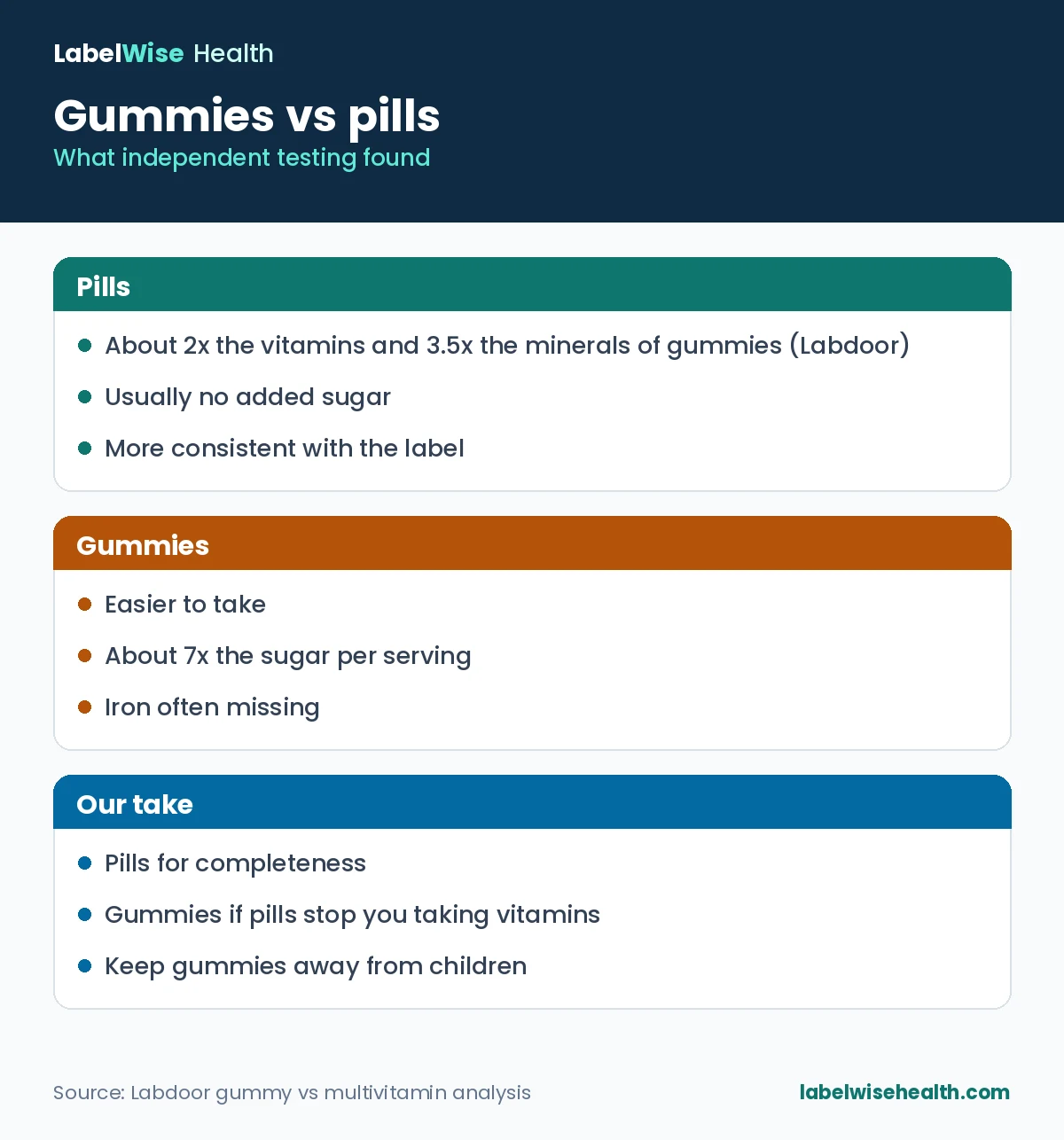
Frequently asked questions
Are gummy vitamins as good as pills?
Not usually for completeness. Testing has found gummies often contain fewer vitamins and minerals per serving, and more sugar. They can still help if they’re the only form you’ll take.
Why don’t gummy vitamins contain iron?
Iron is hard to include in gummies without affecting taste and texture, so many gummy multivitamins leave it out or contain very little.
How much sugar is in gummy vitamins?
It varies, but often a few grams per serving. Check the Total Sugars line on the Supplement Facts label.
Are gummy vitamins safe for kids?
Use products made for children and follow the dose on the label. Store them out of reach, because they look like candy and children can eat too many.
Can adults take gummy vitamins?
Yes. Choose a third-party tested product, check the sugar content, and make sure it contains the nutrients you need.
Sources
- Labdoor: Gummy vitamins vs standard multivitamins
- Deseret News: Gummy vitamins or multivitamins (JAMA melatonin study)
- Community Voice: Gummies or pills? It depends
- Drug Store News: First USP Verified gummies
This article is for general information and is not medical advice. These statements have not been evaluated by the Food and Drug Administration. Supplements are not intended to diagnose, treat, cure, or prevent any disease. Talk to your healthcare provider before starting any supplement.