A proprietary blend groups several ingredients under one name and shows only the blend’s total weight. FDA rules require the label to name every ingredient and list them in order from heaviest to lightest, but not the amount of each. So you can see what’s inside, but not how much of any one ingredient you’re getting.
Affiliate disclosure: we may earn a commission from qualifying purchases through links on this page, at no extra cost to you. Read our disclosure.
What a proprietary blend is
A proprietary blend is a group of two or more ingredients listed together under one name on the Supplement Facts panel, such as “Energy Matrix” or “Superfood Blend”. The label shows the total weight of the whole blend, but not how much of each ingredient is inside.

What the FDA requires
Under FDA labeling rules (21 CFR 101.36), a proprietary blend on a Supplement Facts panel must:
- Have a name, such as “Proprietary Blend” or a descriptive or made-up name.
- Show the total weight of the blend per serving.
- List every ingredient in the blend.
- List those ingredients in descending order by weight, so the first is the heaviest.
What isn’t required is the amount of each individual ingredient. That’s the gap.
How common they are
An NIH-supported analysis of the Dietary Supplement Label Database found that, as of April 2022, about 21% of labels listed ingredients in proprietary blends. They’re especially common in products with many botanical or “performance” ingredients.
How to read one: a worked example
Imagine a label that says “Focus Blend 500 mg”, then lists ingredient A, ingredient B, ingredient C and ingredient D.
- Ingredient A is the largest, because the list is in descending order by weight.
- Ingredient D is the smallest, and could be a tiny amount.
- All four share 500 mg. If the front of the box highlights ingredient C, there may be very little of it.
- Compare the total with what you’re looking for. If a single ingredient is usually studied at more than the blend’s entire weight, the blend can’t contain that much.
Should you avoid proprietary blends?
Not automatically. Some brands use them to protect a formula. But if you want to know exactly how much of each ingredient you’re taking, choose a fully disclosed label, where every ingredient has its own amount listed. A third-party seal adds another check: see what third-party tested means.
Budget multivitamins usually list every nutrient with its own amount and % Daily Value. Check the Supplement Facts image in the listing before you buy.
Browse USP Verified multivitamins on Amazon →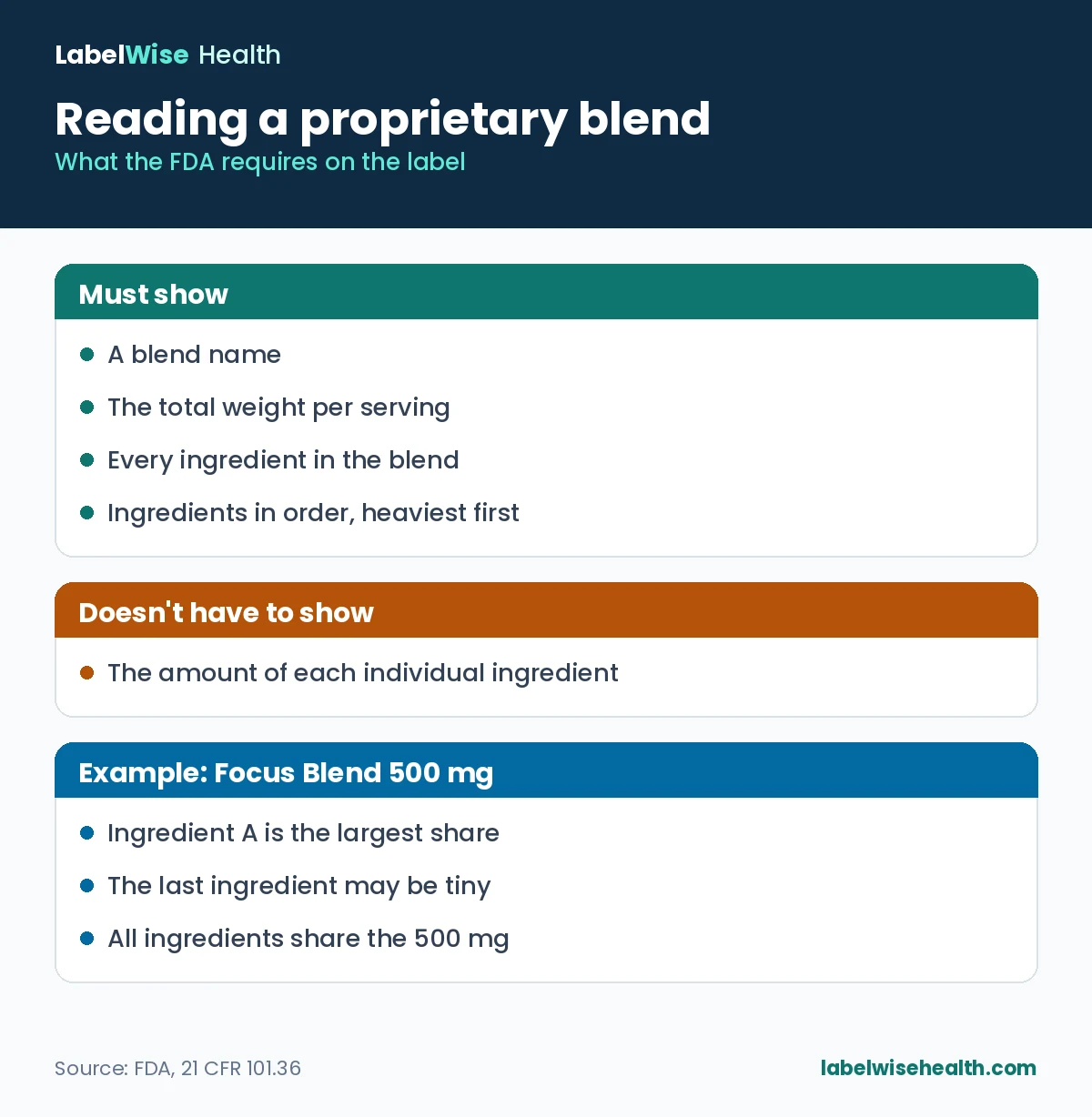
Frequently asked questions
What does proprietary blend mean on a supplement label?
It’s a group of ingredients listed under one name with only the total weight shown, not the amount of each ingredient.
Is a proprietary blend legal?
Yes. FDA rules allow it, as long as the label shows the blend’s total weight, names every ingredient, and lists them in descending order by weight.
How can I tell how much of each ingredient is in a blend?
You can’t from the label. You only know the order by weight and the total. The first ingredient is the largest and the last is the smallest.
Are proprietary blends bad?
Not always, but they make it hard to know your exact dose. If that matters to you, choose a label that lists every ingredient’s amount.
Do multivitamins use proprietary blends?
Most list each vitamin and mineral separately with a % Daily Value. Blends usually appear for extra ingredients, like herbs or ‘superfoods’.
Sources
- FDA: Letter citing 21 CFR 101.36 proprietary blend requirements
- NIH PMC: Proprietary blends in the Dietary Supplement Label Database
- BSCG: FDA supplement label requirements
- SuppCo: Should you trust a proprietary blend?
This article is for general information and is not medical advice. These statements have not been evaluated by the Food and Drug Administration. Supplements are not intended to diagnose, treat, cure, or prevent any disease. Talk to your healthcare provider before starting any supplement.